

With traffic expected to pick up over the final long weekend of summer, drivers across the Kootenays are being reminded that flashing amber lights at the roadside carry the same Slow Down, Move Over requirements as flashing emergency lights.
A Road Safety at Work survey conducted this year found 98 per cent of respondents knew the law applies when emergency vehicles such as police cars, ambulances and fire trucks display flashing red and blue lights.
However, only 30 per cent knew drivers must follow the same rules when stopped vehicles display flashing amber lights, including tow trucks, highway maintenance vehicles, utility vehicles and waste collection trucks.
“Most drivers would never intentionally put a roadside worker at risk,” said Trace Acres, Program Director for Road Safety at Work. “The few seconds it takes to slow down and move over could save someone’s life. Watching for flashing amber lights should be as automatic as watching for flashing red and blue lights.”
WorkSafeBC statistics show 11 roadside workers were killed and another 263 were injured seriously enough to miss work in B.C. between 2016 and 2025.
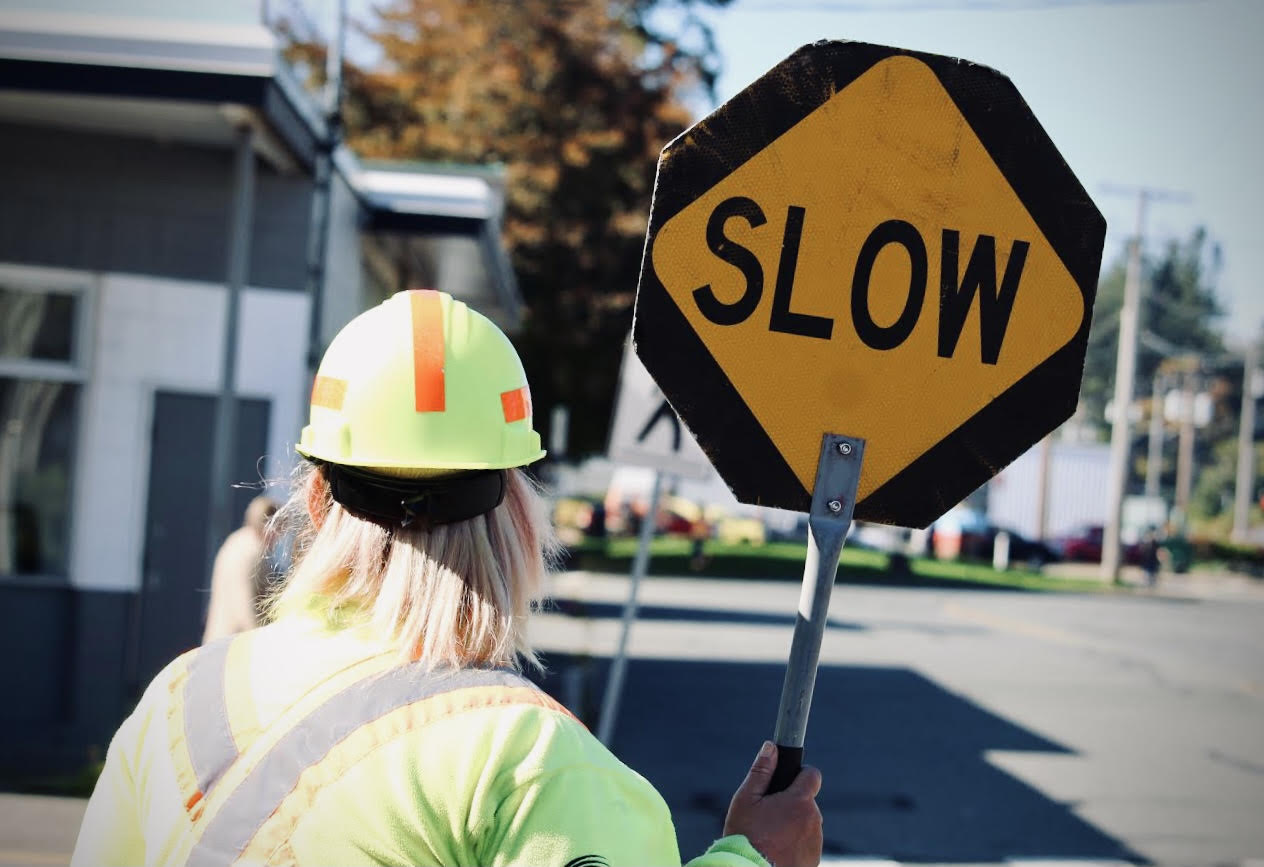
Roadside workers include construction and maintenance crews, tow truck operators, utility workers, landscapers, garbage and recycling collectors and emergency responders.
Under B.C.’s Slow Down, Move Over law, drivers approaching a stopped vehicle with flashing red, blue or amber lights must slow to 70 km/h when the posted speed limit is 80 km/h or higher. Where the posted limit is below 80 km/h, drivers must slow to 40 km/h.
On multi-lane roads, drivers travelling beside the stopped vehicle must also move into another lane if it is safe to do so.
Drivers approaching or travelling through roadside work zones should obey posted speed limits, signs, traffic control devices and directions from traffic control personnel.
Failing to follow the Slow Down, Move Over law can result in a $173 fine and three penalty points. Other work zone violations can carry higher penalties, including a $368 fine for using an electronic device while driving.
The Road Safety at Work survey was conducted in March among 1,000 people who drive for work, including people who drive as a primary part of their job and those who drive for work occasionally.
Road Safety at Work is a WorkSafeBC-funded injury-reduction initiative managed by the Justice Institute of British Columbia.