
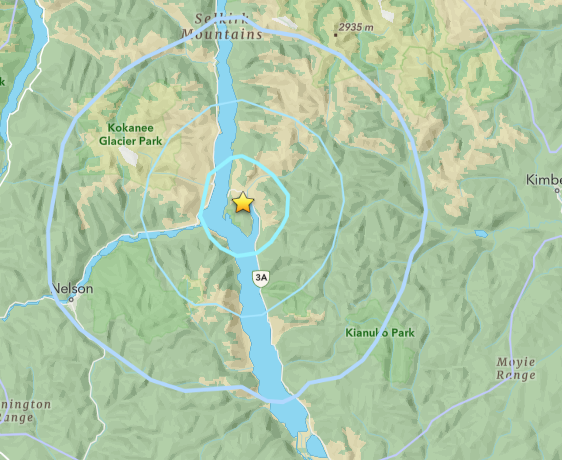

The early-morning earthquake that rattled the Kootenays on Thursday is within the range of seismic activity expected in the region, according to a Natural Resources Canada seismologist.
Seismologist Camille Brillon said the magnitude 3.7 earthquake near Crawford Bay was felt up to about 150 kilometres from the epicentre.
“It was actually preceded by two smaller events that were likely unfelt, a magnitude 2.6 at 12:27 a.m. and a magnitude 2.7 at 12:30 a.m.,” said Brillon.
She said people close to the epicentre reported moderate to strong shaking, including shelves and pictures rattling.
“The intensity was around intensity four,” she said. “And there has not been any aftershocks. There might be another earthquake of similar or smaller size, we can’t really say, but this is not a precursor to a big, significantly damaging earthquake.”
Brillon said the quake’s shallow depth of about four kilometres also helped make the shaking more noticeable.
She explained that the deeper an earthquake is, the farther the shaking has to travel before reaching the surface.
“An earthquake at four kilometres deep is really just four kilometres away from the person right at the surface.”
And the timing may have played a role too.
Brillon said people were likely still at home or just starting their day, when their surroundings were quieter and they were more likely to notice the movement.
She said earthquakes aren’t unusual in the area, although most are smaller and go unnoticed.
“Seismicity in this area is obviously lower than you would get on Vancouver Island, but there is earthquakes in the area. Most of them are just smaller and if they happen in an area that’s not populated and no one feels them, they kind of go unnoticed.”
There was a magnitude 4.3 earthquake within 100 kilometres of the area in 2023, followed by a magnitude 3.6 earthquake just south of Thursday’s event in May 2026.
There was also some confusion over the earthquake’s magnitude, with the U.S. Geological Survey initially listing it as 4.2 while Natural Resources Canada listed it as 3.7.
Brillon said differences between the two measurements can happen because the agencies use different equations and seismic stations to calculate magnitude.
“The U.S. and Canada use different stations,” she said, explaining that measurements from those stations can produce different results.
She said even Natural Resources Canada can adjust its measurement as more analysis is done.
The agency’s initial automatic reading was 4.1 right after the quake struck, before analysts reviewed the data and refined the calculation.
For residents, Brillon says the event is a good reminder to be prepared for emergencies, including having an emergency kit that can support people and pets for at least 72 hours, but ideally two weeks.
Want to get your business noticed? Have you considered advertising through your local radio station? Speak to one of our sales agents and find out how radio advertising can boost your business today. Call 250-365-7600 or email Vista Radio.